Riemannian residual networks
RResNet and GBWBNRResNet interleave BiMap layers with residual blocks
(nn.rresnet_layers.ResidualBlock), following Katsman et al., Riemannian
Residual Neural Networks, NeurIPS 2023 (arXiv:2310.10013,
reference code).
The residual step
A residual block moves each SPD matrix \(X\) along a learned tangent vector, the Riemannian analogue of \(x + f(x)\):
where \(\operatorname{spec} X\) are the eigenvalues of \(X\), \(f\) a small Conv1d
network (with BatchNorm1d) and \(Q\) a learned orthogonal matrix
(SpectralVectorField). The exponential map is chosen with residual_metric:
"affine_invariant"(default)\(X_{\text{new}} = \operatorname{projx}\big(\mathrm{Exp}_X(V / \lVert V \rVert_X)\big)\) with \(\lVert V \rVert_X = \lVert X^{-1/2} V X^{-1/2} \rVert_F\): every block moves by exactly one unit of affine-invariant distance, and
projxclamps the eigenvalues to \([10^{-8}, 10^{8}]\). This is what the reference code does."log_euclidean"\(X_{\text{new}} = \exp\big(\log X + V\big)\), the variant that performs best on 3 of the 4 datasets of the paper.
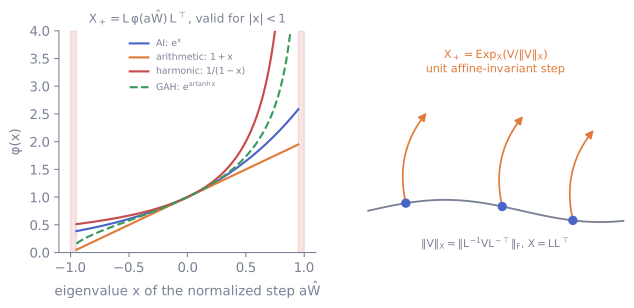
Left: other residual steps \(X_+ = L\,\varphi(a\hat W)\,L^\top\) (arithmetic, harmonic, GAH) agree with the affine-invariant exponential to first order and are valid for \(|x| < 1\). Right: the unit affine-invariant step.
Numerically singular inputs
The affine-invariant step computes \(\lVert V \rVert_X\) with a Cholesky
factorization of \(X\). After a batch normalization, \(X\) can be numerically
singular: the Bures–Wasserstein steps of GBWBN fold matrices that leave the
injectivity domain of their exponential (see Batch normalization), and very
ill-conditioned batches reach the limit of float64 precision. The block
therefore floors the eigenvalues of its input at \(10^{-8}\) (the lower bound
of projx), with the hand-differentiated ReEig. On well-conditioned inputs
the floor is exactly the identity, values and gradients.
Why the normalization matters
\(\lVert V \rVert_X\) grows like \(1 / \lambda_{\min}(X)\). On real covariances,
for instance HyperLeaf with eigenvalues from \(10^{-4}\) to \(3 \cdot 10^{3}\),
an unnormalized \(V\) of Frobenius norm about 3 has an affine-invariant norm
about \(2 \cdot 10^{3}\). The matrix exponential then overflows, and the next
eigendecomposition fails. The normalized step, like the log-Euclidean one,
stays finite for any conditioning. tests/nn/test_rresnet_layers.py
(TestResidualBlockIllConditioned) checks this on matrices spanning that
range.
from yetanotherspdnet import RResNet

model = RResNet(
    input_dim=204,
    hidden_layers_size=[100, 50],
    n_residual_blocks=[1, 1],  # one block after each BiMap
    output_dim=4,
    residual_metric="log_euclidean",
)